2016年4月17日星期日

Naoto Fukasawa JUICE PEEL Packaging

                
                   Naoto Fukasawa JUICE PEEL Packaging


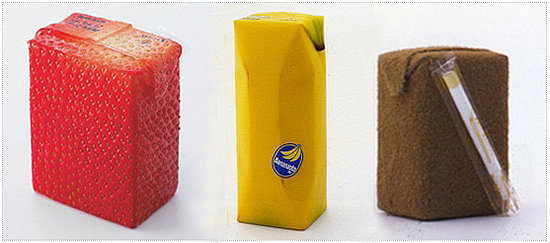
Those package is called “Juice Skin” was that the packages were not only colored, but also textured to resemble specific fruits, this is a very funny and successful example of a design about sensory marketing.

Developed for the haptic exhibition held in Tokyo in 2004, Juice Skin consists of juice boxes that appear to be wrapped in the actual skins of the fruit whose juice they contain. When first seen, the effect of the juice boxes is immediate: audiences quickly comprehend both the contents of the objects. 


There were more fruits involved than the frequently photographed, banana juice, strawberry and kiwi fruit juice boxes.  Fukasawa had also created containers for soy milk, green apple and peach juice.

Fukasawa had used a number of different Tetra Pak containers to contain his six proposed flavours, including Tetra Prisma packaging for the banana beverage, the familiar gable top cartons for peach juice and Tetra Brik juice boxes for the other 4 flavours.

When thinking of objects where there's a marked contact with paper, what leapt to mind was a paper drink pack. That slight weightiness, the chill and the beads of water on the surface, and the sense of holding a liquid form a set, together with the flavour of the drink. The skin of a fruit is also part of a set, with the juice, the flavour contained within that skin, and the feel of it. Fukasawa believed that a design that imparted the idea that the taste could be received tactilely would fit in with the exhibition's theme. Things developed from there, and he also designed packs for soymilk, kiwifruit juice, peach juice and strawberry juice. The soymilk pack’s surface was given a texture like that of firm tofu. With the kiwifruit and peach-juice packs, fuzz like that found on the skin of each fruit was applied. The strawberry juice pack had small seeds embedded in its surface. They all turned out rather strange-looking, but a lot of interesting discoveries were made along the way.
He understood that the feel of things people touch unconsciously on a daily basis is committed to memory along with that thing's taste and smell; by awakening in an over-the-top way those senses of which they are unaware, it was possible to create a mischievous design With these packs. Which are a bit off-putting to look at, if the juice inside tastes good, then they'll be designs that people will not be able to forget, that they will not be able to let go. 

2016年4月2日星期六

Fairy tale world - Disney, branding experience management


                                Fairy tale world - Disney

                                                                             Branding Experience Management    

Actually, this topic make me remember a news I read on website last few days, a little girl who can not hear the voice visit Disney land and want to take a photo with Tinker Bell as her favorite character of Disney animated movie, when she stand in front of tinker bell, maybe she never can imaging that tinker bell use sign language talk with her, she look very supervise and happy. In lots of people's mind, they believe the responsibility of Disney is bring that magic and amazing fairy tale world to every one who have that dream. so for the brand experience of Disney is basic to make sure that every visitor can get they special experience in Disney land. 

From first logo of Disney, they have never change their main idea, the symbol of Disney is a castle such like every fairy tale movie with a blooming fireworks to make people feel that so strong culture around their theme, and on another hand, in order for to protect their brand and make sure the high level quality of their product, they are very strict management of their brands, they won't distributed any of their own product to other factories which not being control by them.

By the way,   all of visitor know that the theme is a very important point for Disney land,If you take away the theming, there’s nothing particularly special about Disneyland’s rides. Tame roller coasters, generic log flumes, perfectly ordinary carousels—off-the-shelf mid-range rides you could go on at any theme park. In fact, several nearby parks have far more extreme and exciting rides.

The thing is, Disney’s theming isn’t just slapping a few cartoon animals on the sides of rides. It’s immersive, complete and, in its own cheesier-than-France way, kind of classy.

It makes sure its Fantasyland cast members don’t wander through Frontierland dressed in costumes with the wrong theming. It pumps out scents for each ride—brine for Pirates of the Caribbean, honey for Winnie-the-Pooh, and a cold, musty smell for the Haunted Mansion. The carparks aren’t called A, B and C—instead there’s Pumba Parking, the Mickey and Friends Parking Structure, and Toy Story Parking.

Similarly, the “business” areas of Disneyland like loading zones or cleaning cupboards are cleverly hidden in “offstage” areas. Cast members are strictly forbidden to “remove their heads” in view of any guests (children or adults). 

Even tiny details like the autographs characters give out are exactingly themed. Actors must learn to replicate the signature of their character; a Belle signature in Disneyland should look identical to a Belle signature in Disney world Tokyo six years later.

The immersive element is pervasive. Even the doorknobs and cutlery contain the iconic Mickey-head shape—just in case you forget you’re in Disneyland.


A number of Disney films are about being a special and unique snowflake. And astonishingly, despite the positively enormous numbers of people churning through the gates each day, Disney staff actually do treat their guests like snowflakes.

“disney land”的图片搜索结果Cast members give children badges and balloons at random; princesses stop to greet little girls dressed in princess gear; guests are allowed to “captain” the Jungle Cruise or Mark Twain Riverboat.

Disney is famous for being especially considerate to guests with disabilities, ranging from claustrophobia to autism—and it’s scrupulous about accommodating food allergies. The perpetually bubbly staff do their best to make sure every guest feels special.

In general, Disneyland hides its “seams”. Trees that need cutting down are switched during the night with fully-grown replacements from Disney’s nursery. Cleaners are inconspicuous. Staff areas are hidden underground or painted “no-see-um” green and shrouded in foliage.

Hordes of guests are guided through Walt Disney’s hidden Main Street apartment (in which a light is always kept symbolically burning). The names of the Imagineers are featured on the shop windows of Main Street. The Lily Belle, a train-car designed for Walt’s wife, is a major photo-op attraction; as is the sentimental “Partners” statue of Walt and Mickey.

And Disney never lets anyone forget its past successes. Its parades are a constant triumph of its classics—in fact, it has reached the point where it can simply manufacture classics, labeling them as such before they’ve even come out on DVD. When Tiana and Rapunzel were inaugurated into Disney’s official princess lineup, the marketing made it a quasi-historical occasion—and thousands upon thousands of loyal customers showed up.